![[Translate to English:]](/fileadmin/_processed_/8/0/csm_Forschung_989f311f3b.jpg)
Stability and Change in the Legitimation of the German Pension System
Against a backdrop of demographic change, growing social inequalities, fiscal pressures and heated debates on reform, political decisions regarding the pension system are being taken under considerable pressure. This directly affects all stakeholders in pension policy. To ensure that political decisions, structural reforms or communication strategies, for example, not only function effectively in technical terms but also resonate with society, empirical insights into citizens’ subjective preferences and assessments are indispensable.
This research project therefore investigates the individual development and change in preferences and assessments of the German pension system over time. The starting point is the assumption that the social legitimation of old-age provision arises from an interplay of preferences and evaluations based on different conceptions of fairness. These are modelled as typical profiles, which differ between individuals and may change intraindividually over time or remain stable. The focus is on analysing transitions between these profiles and their interrelationships.
For example, we can provide insights into which paradigms of old-age provision (such as equality, status preservation, private provision, solidarity) have been preferred in recent years and at what points in time they are associated with a positive or negative assessment of the principle of equivalence.
In a second step, changes in employment status, interactions with the pension system (e.g. transition to retirement or the use of private and occupational pension schemes) and affiliation with specific occupational sectors are examined as key factors influencing the subjective formation of preferences and evaluations. The project thus contributes to an understanding of the social legitimacy of the statutory pension scheme by demonstrating how individual employment histories and interactions with the system shape perceptions of and evaluations regarding old-age provision.
Research programme and methodology:
The empirical analyses are based on data from the German Ageing Survey (DEAS). For the present study, the 2008, 2011, 2014, 2017, 2020/21 and 2023 waves are used, enabling the analysis of both long-term trends and individual changes over a period of 15 years. The data are based on a representative panel survey of the resident population of Germany in the second half of their lives living in private households, thereby providing particularly valuable insight into the preferences and assessments of age cohorts who are current or soon-to-be recipients of the statutory pension scheme (GRV). A scale comprising a total of nine items relating to various paradigms and principles of the German old-age pension scheme is examined using methods from the field of latent class analysis.
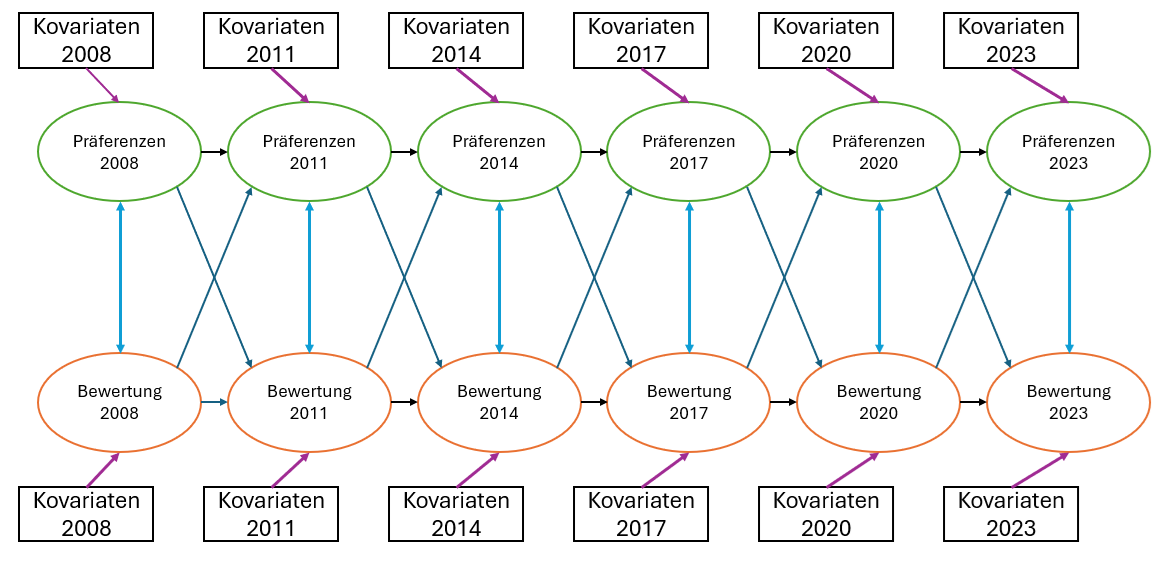
As a first step, preferences and evaluations are modelled using latent transition analysis (RI-LTA). This method allows the analysis of individual transition probabilities between profiles of preferences or evaluations. At the same time, it is possible to investigate whether certain preference or valuation profiles gain or lose significance over time. Subsequently, preferences and valuations are combined into a single model. This allows for the examination of relationships between preferences and valuations across two survey waves.
In the second step, employment- and occupation-related covariates are integrated into the models. As part of the model specification, we examine which covariates have significant effects and to what extent their inclusion contributes to improving model quality. Overall, this approach enables a nuanced analysis of the covariates, both in terms of their direct effects on transition probabilities and their moderating effects on the temporal relationships between preference and evaluation processes.
The project is funded by the Research Network on Old-Age Provision (FNA).
Planned duration: October 2026 to September 2027
The following staff members at DZA are involved

Principal Investigator
Principal Investigator
Principal Investigator

Principal Investigator

Assistant

Cooperating bachelor student